

Open Letter Danish Climate Minister Samira Nawa: Stop Hejre!
Dear Minister of Climate, Energy and Utilities Samira Nawa
Ineos E&P has once again applied for a permit to extract oil and gas from the Hejre field in the Danish part of the North Sea. This comes after the Danish Energy Board of Appeal revoked the previous permit following a Greenpeace complaint that found inadequate information in the environmental impact report. Ineos has now added an assessment of the field’s indirect environmental and climate impacts – the so-called scope 3 emissions. This amounts to 47.5 million tonnes of CO2, which is more than the entire country of Denmark emitted in 2025. Despite the staggering level of greenhouse gas emissions, Ineos assesses that the project will not significantly affect the climate.
We strongly challenge this assessment. There are just as many important reasons today to stop the controversial Hejre field as when Ineos initially applied for a production permit.
The climate crisis is raging, causing forest fires, floods, record heat, and droughts, and the consequences are hitting the most vulnerable in society hardest, not to mention future generations. The climate crisis is largely due – 74.5% according to Ineos’ own scope 3 supplement – to the burning of fossil fuels.
For decades, climate scientists and the international community have been calling for an urgent phase-out of fossil fuels. Allowing one of the world’s largest and most controversial plastic producers to extract new oil and gas from the North Sea for 20 years would not only be an admission of failure, it would also be a death sentence for the world’s ecosystems and most vulnerable populations in the Global South, which are already suffocating under extreme temperatures and plastic pollution. This project would also be an economic disaster for all Danes, whose homes will be destroyed by climate-related floods and who will be hit by rising food prices due to failed harvests caused by extreme weather. Finally, it will be catastrophic for public health, as air pollution and heat waves caused by fossil fuel burning kill thousands of people every year, just in Europe. Worldwide, it is estimated that over 8 million people die annually due to air pollution, of which a significant proportion of deaths are caused by the burning of fossil fuels.
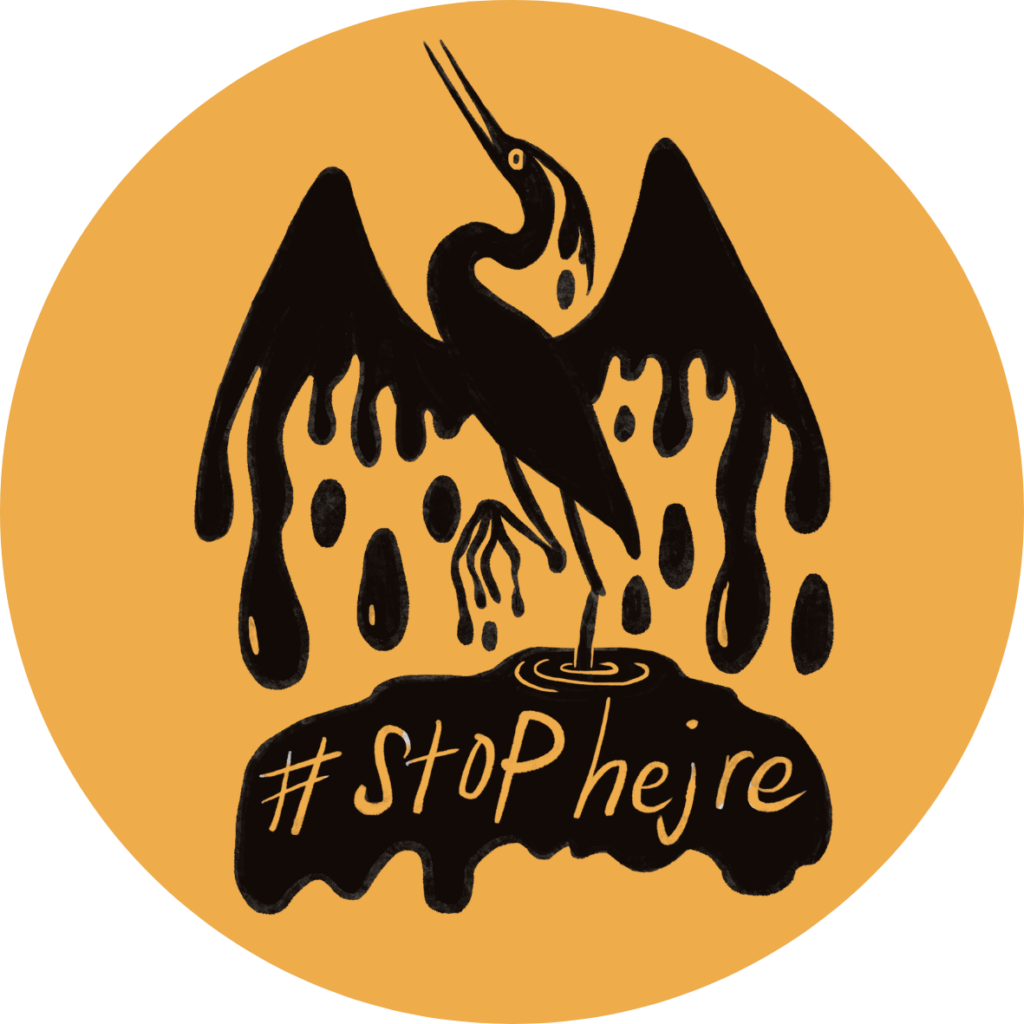
Ineos ignores all of this in their environmental impact report. Instead, the company points out that the project will have positive effects on energy security, employment and tax revenues. However, all three arguments are highly questionable.
On energy security, the oil from the Hejre field – like oil from Ineos’ other Danish fields – will be sold to refineries in countries like Sweden, Germany and the Netherlands, and therefore will not affect Danish energy security. Rather, the Hejre field, with its tumultuous history, has led to serious miscalculations in the Danish Energy Agency’s production forecasts over the past 10-15 years. The overestimation of production volumes from the North Sea has damaged energy planning and, as a result, Denmark’s energy security years. Add to that the fact that any delay in the fossil fuel phase-out worsens the climate crisis. This increases the threat of war and the collapse of global supply chains, which directly threaten the security of Denmark, Europe, and the rest of the planet.
It is also doubtful that Hejrefeltet will have a positive effect on employment in the country. Hejre will be controlled remotely from the existing Syd Arne platform, where no additional staff is expected as a result of the field’s connection. The contracts for the work of producing the platform for Hejre and pipelines, etc., were also awarded to foreign companies in Norway, Scotland and Italy in Ineos’ previous Hejre project. Ineos gives us no reason to believe that the same will not happen again. The project is therefore unlikely to have a positive effect on employment in Denmark, but on the contrary, will take up workers and government resources that could instead be used to build renewable energy.
The claim that the Hejre field would generate tax revenue for the Danish state is also questionable. Ineos has such large tax deductions that even in 2022, when oil and gas prices were at their highest, it paid neither corporate nor hydrocarbon tax in Denmark. An analysis from the Enterprise Think Tank from 2025 also mentions that no tax revenue is expected from Ineos’ fields in the North Sea until 2050. Claiming that the Hejre field will contribute positively to the treasury is at best uncertain, and at worst a deliberate act of misinformation.
Finally, Ineos does not address the effect of the estimated scope 3 emissions of 47.5 million tons of CO2. The effects of these emissions include damage in the billions, the loss of thousands of lives, and an increased risk of tipping points in the climate system, such as the collapse of the AMOC. Based on international research, Greenpeace has calculated that the 47.5 million tons of CO2 will lead to 10,700 deaths due to unbearable heat alone. To this should be added deaths due to flooding, the spread of disease and other derived effects of an intensified climate crisis. A conservative estimate of the destruction of USD 185/ton CO2 would mean that the Hejre field would cause damage worth 57 billion kroner during its lifetime. This amount far exceeds the field’s total socio-economic value. The fact that the project includes an option to expand the number of wells, which is not included in Ineos’ scope 3 assessment, means that this amount may even be underestimated.
Ineos believes that the project will not jeopardize the goals of the Danish Climate Act, the EU climate goals or the Paris Agreement. This is completely wrong. Ineos’ assessment is based on a goal of keeping global temperature increase below 2.0 degrees, rather than significantly below 2.0 degrees, aiming for 1.5 degrees, as agreed in both the Climate Act and the Paris Agreement. The International Court of Justice advisory opinion also makes it clear that the 1.5-degree goal is what applies. Aiming for or planning higher temperatures is considered a violation of human rights. The International Energy Agency has already concluded in 2021 that new coal, oil and gas projects are not compatible with our climate goals.
Finally, it should be pointed out that Ineos claims that the Hejre field simply satisfies “a need for oil and gas for many years, until the world’s energy needs can be fully covered by renewable energy.” However, this couldn’t be more wrong. Decisions we make today about energy efficiency, heating solutions, transportation, construction, installation of renewable energy and the like directly affect future demand.
So, dear Minister of Climate, Energy and Utilities Samira Nawa: It is clearly unjustifiable to open a new oil field given the seriousness of the climate crisis and the available energy alternatives. Especially when Denmark likes to call itself a ‘green pioneer country,’ and we, as initiators and co-founders of the Beyond Oil and Gas Alliance, have explicitly committed ourselves to stopping new concessions, licenses and tender rounds for oil and gas production and exploration and to setting a Paris-compatible end date for production.
Allowing this new oil field neither provides security of supply, employment or tax revenues, and to the contrary risks distracting us and delaying electrification, according to Jan Rosenow, professor of energy and climate law at Oxford University.
Instead of allowing new fossil production, you, as Minister of Climate, Energy and Utilities, should focus resources on policies that ensure real energy independence and secure our climate goals, including large-scale deployment of renewable energy. This is an agenda that Ineos does not contribute to, but instead directly opposes. In Denmark, they have acknowledged that they will not build windmills, and internationally, they are intentionally seeking to stimulate oil demand through, for example, lobbying and influencer campaigns for single-use plastic. For this reason, too, the Danish state should not grant Ineos permission to operate in Denmark.
We hope that you will take note of our and the many other public responses and agitate against a permit for fossil fuel production from the Hejre field.
Kind regards,
Fossilfree Future Denmark and the entire international community fighting for climate survival
Oil Change International
EKOenergy ecolabel
Extinction Rebellion Linköping
Elokapina/Extinction Rebellion Finland
Stop Rosebank
Climate Camp Scotland
Mothers Rise Up
Weald Action Group
Christian Climate Action
Earth Ethics, Inc.
Aoteaoroa New Zealand Architects Declare
Grandmothers Act to Save the Planet (GASP)
Vasemmistonuoret/Left youth of Finland
Platform London
Greta Thunberg from Sweden
Elvin Landaeus Csizmadia – musician from Sweden
Mannes Kocken – campaigner from the Netherlands
Kim Claes – campaigner from Belgium
Jesse van Schaik – youth movement organizer and student from the Netherlands
Petra Kairinen – researcher from Finland
Ville Laitinen from Finland
Kaisla Mäkipuro – environmental engineering student from Finland
Sade Julia Palviainen – water technician student from Finland
Eetu Nummelin – maintenance engineer from Finland
Laura Saarinen – engineering student from Finland
Mari Tuominen from Finland
Alina Grön – student from Finland
Janna Jokela from Finland
Sanna Laakso from Finland
Outi Suhonen from Finland
Anne Uotil – medical doctor from Finland
Iiro Rinne – software developer from Finland
Olli Oinonen – R&D engineer from Finland
Karoliina Saastamoinen – theater artist from Finland
Suvi Korhonen from Finland
Otto Bruun – researcher and vice chairperson of the Left Alliance from Finland
Kate Whitaker from Scotland
Liam McAllan from Scotland
Nera Cornell – Ecologist from the United Kingdom
Versha Jones – Graphic Designer from the United Kingdom
Aura Niskanen from Finland
Joonas Jormalainen – student from Finland
Lars Sözüer from Germany
Sarah Finch – editor from the United Kingdom
Marit Fontana Oscarsson – psychologist from Sweden
Lotta Kiviluoto – student from Finland
Vilho Virtanen from Finland
Matti Niskanen from Finland
Lumi Suomi from Finland
Ronja Rautiainen – student from Finland
Mira Karjalainen – researcher from Finland
Ronja Olga Maria Antikainen – dance artist from Finland
Vilma Kortesniemi from Finland
Kaisu Ikonen from Finland
Emma Seppälä – Barmaid from Finland
Santeri Junttila from Estonia
Otso Piitulainen from Finland
Luontoliitto Ry from Finland
Iris Kinni from Finland
Meri Seppälä – student from Finland
Utu Vahtera – student from Finland
Miina Myllymäki from Finland
Dilwin akinci from Finland
Tanja Rastad – IT consultant from Sweden
Amanda Gröhn from Finland
Anetta Kukkonen from Finland
Sivi Ihalainen – librarian from Finland
Christer Felix from Sweden
Karin Sandén – psychiatrist from Sweden
Saimi Herlevi – student and local politician from Finland
Johanna Arderup – student from Sweden
Milla Haugen – activist from Norway
Teodor Wensell Guttulsrød from Norway
Denis Zimarev – student from Norway
Maja Ringeling – student from Norway
Skylar Graves – student from Finland
Hanna Vedenheimo – occupational therapist from Finland
Mary Weir – retiree from the United Kingdom
Michael Rozdoba – physiotherapist from the United Kingdom
Heather Harrison – Pharmacist from the United Kingdom
Peter Morrow from the United Kingdom
Carl Busby from the United Kingdom
Sue Metcalfe – doctor from the United Kingdom
Tatjana Boric – editor in chief from Sweden
Dr Hayley Pinto – doctor from the United Kingdom
Mr G J Allan – podiatrist from the United Kingdom
Valentina Formenti from the United Kingdom